Operator, licence and rakeback rows are Duel-stated; speed, fee, KYC and score rows are CB-measured from real-money tests. Point-in-time — verify current terms before depositing.
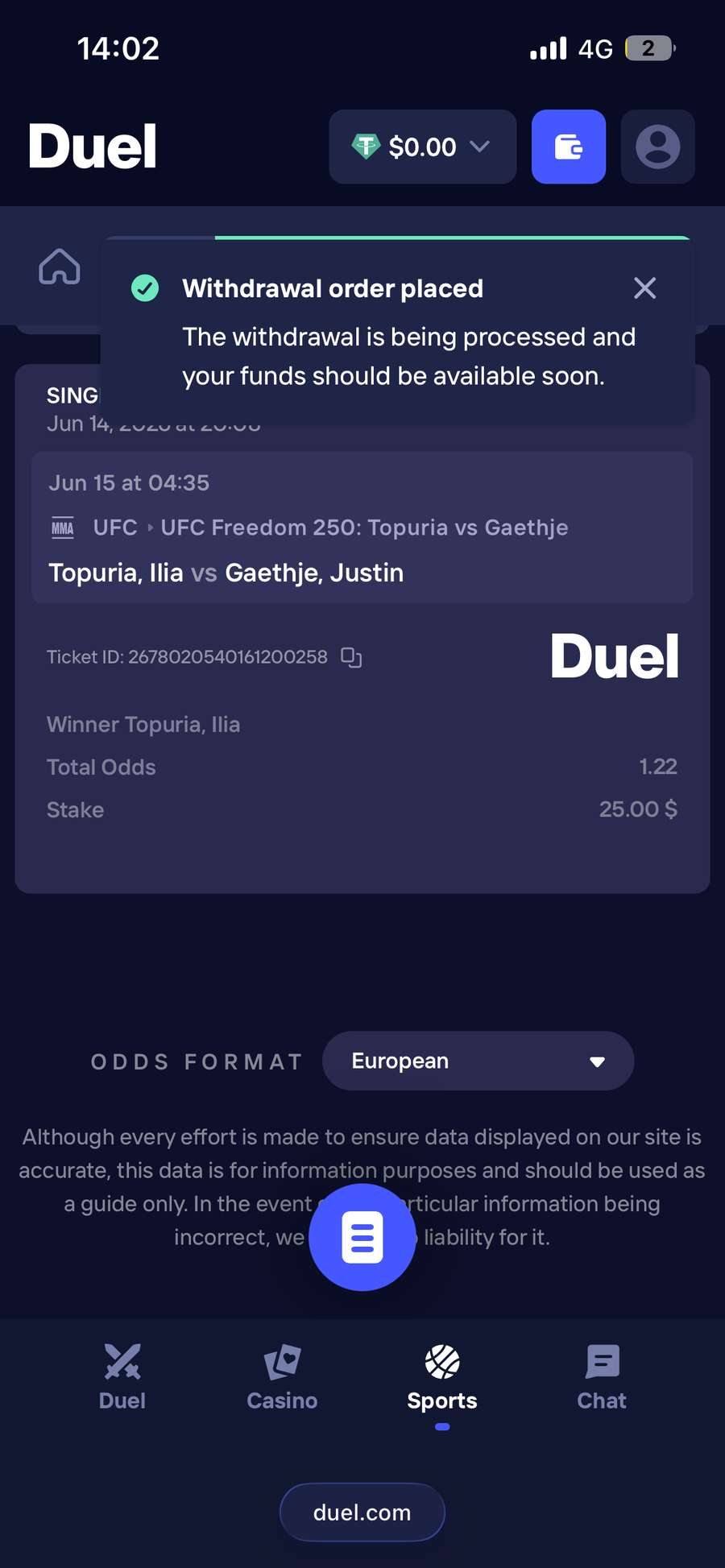
- 29-second withdrawal, verified on-chain via Etherscan
- No KYC across two full cycles (no email required)
- Cross-network withdrawals — verified in testing
- Lowest withdrawal fees of any CB-tested platform
- Wager-free rakeback (50–80%) from the first bet
- 100% deposit wagering can apply (8% fee to bypass)
- TRC-20 withdrawal fee is high (~$4.38) — use SOL/ERC-20
- Odds quality not yet tested — score is provisional
- Newer platform (launched 2025), offshore Anjouan licence
- No privacy coins; no dedicated mobile app
This is a provisional score. Duel.com has been tested on nine of ten methodology dimensions — 85% coverage. Only odds quality (15% weight) is still to be tested. The overall is the weighted average of the dimensions tested so far, so it may move once odds are measured. CB publishes provisional scores once coverage is substantial and marks them clearly rather than waiting for 100%.
Duel.com is fast, cheap and privacy-friendly — a $10 deposit confirmed on-chain and a withdrawal that landed in 29 seconds, verified on Etherscan. Across three withdrawal tests on two networks, every one cleared in under 35 seconds — the most consistent record in CB's dataset — with no KYC across two full cycles (no email required). Withdrawal fees are the lowest CB has measured ($0.16 ERC-20), rakeback is wager-free from the first bet, and Duel supports cross-network withdrawals so you can route around a pricier chain. Two points to plan for: a 100% deposit-wagering requirement can apply before withdrawal (bypassable for an 8% fee, and absent on CB's last cycle), and TRC-20 withdrawals carry a higher ~$4.38 fee. Odds quality isn't yet tested, so this is a provisional 8.9 at 85% coverage.
Every score above comes from a documented real-money test. Compare this with certification models that record only whether a casino commits to a standard — CB scores what actually happened when money moved. Weighting follows CB's published methodology.
01Withdrawal speed — 29 seconds, verified on-chain
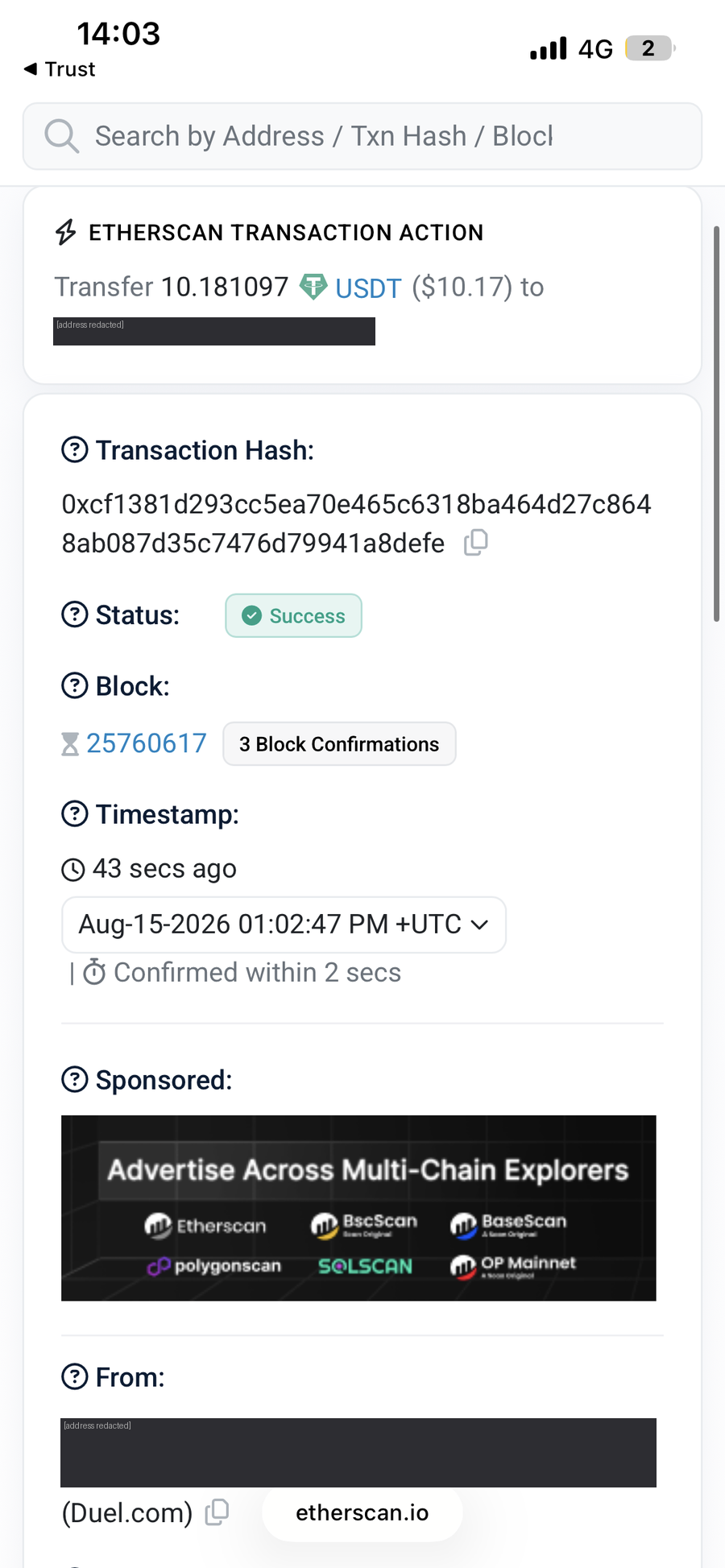
A USDT-ERC20 withdrawal landed in 29 seconds. Across three tests on two networks, every one cleared in under 35 seconds.
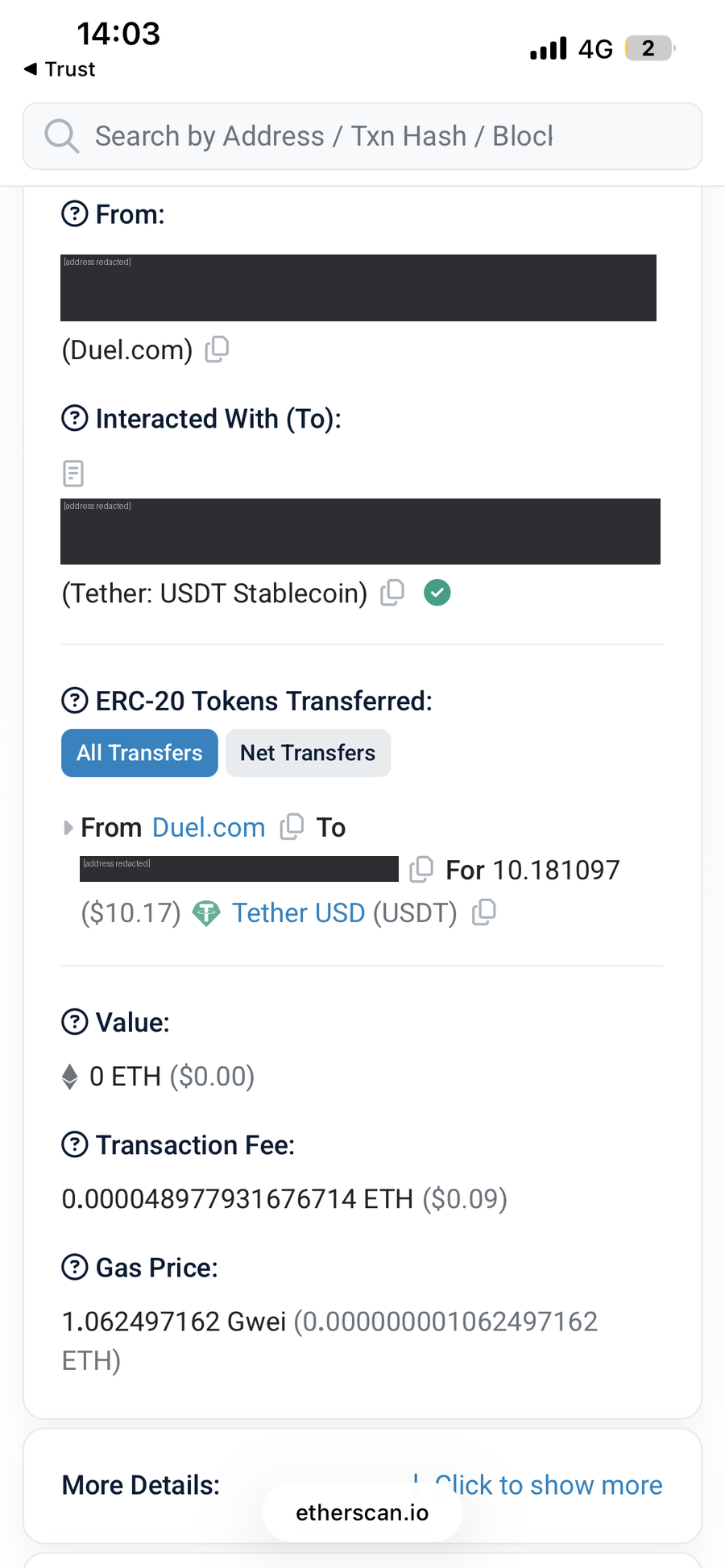
Withdrawal reliability is Duel's standout. CB has now run three real-money withdrawals across three separate sessions — two on Solana (28s and 32s) and one on ERC-20 (29s) — and every one landed in under 35 seconds. That's the most consistent withdrawal-speed record in CB's entire dataset. The most recent test, a 10.33 USDT ERC-20 withdrawal, is verifiable on-chain: Etherscan shows the transfer confirmed within 2 seconds of broadcast.
02The deposit — fast and on-chain
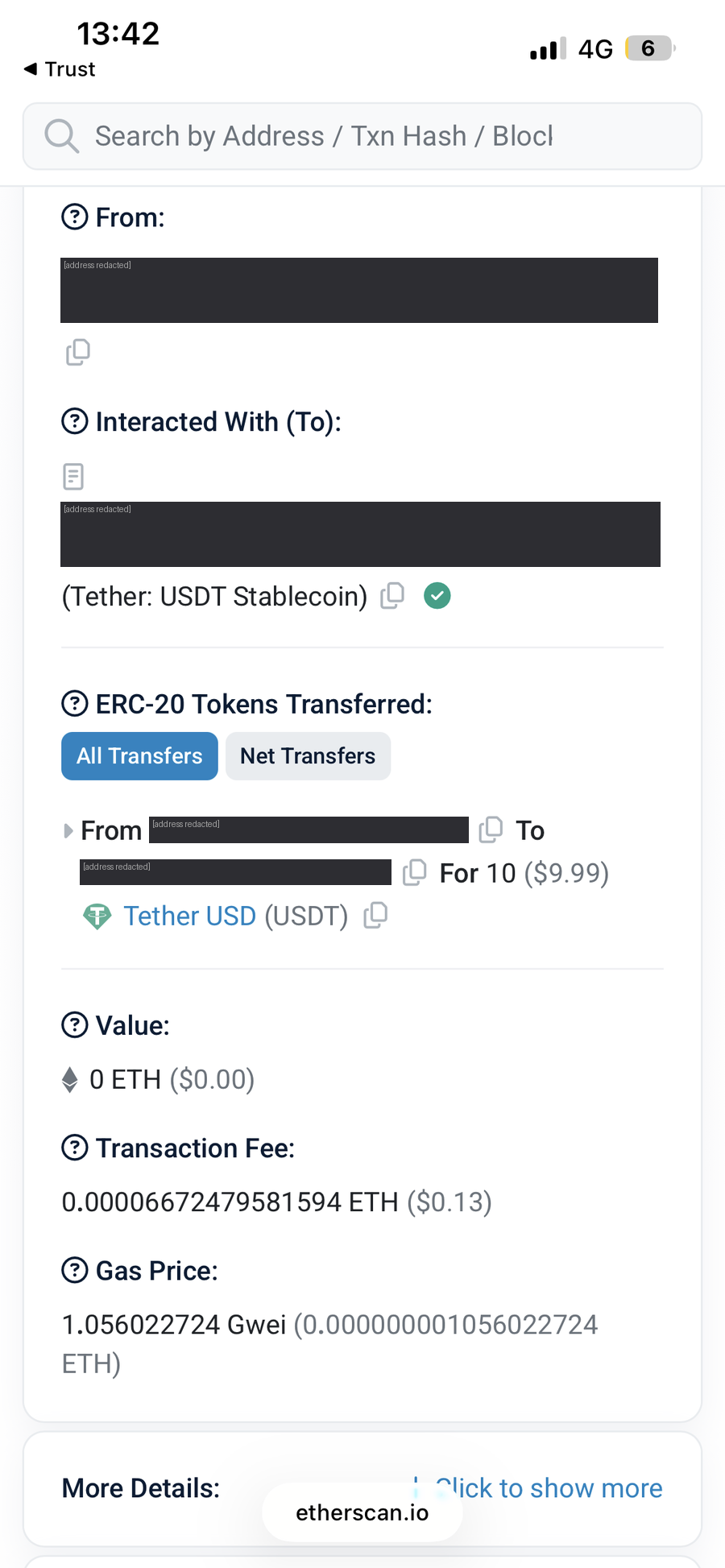
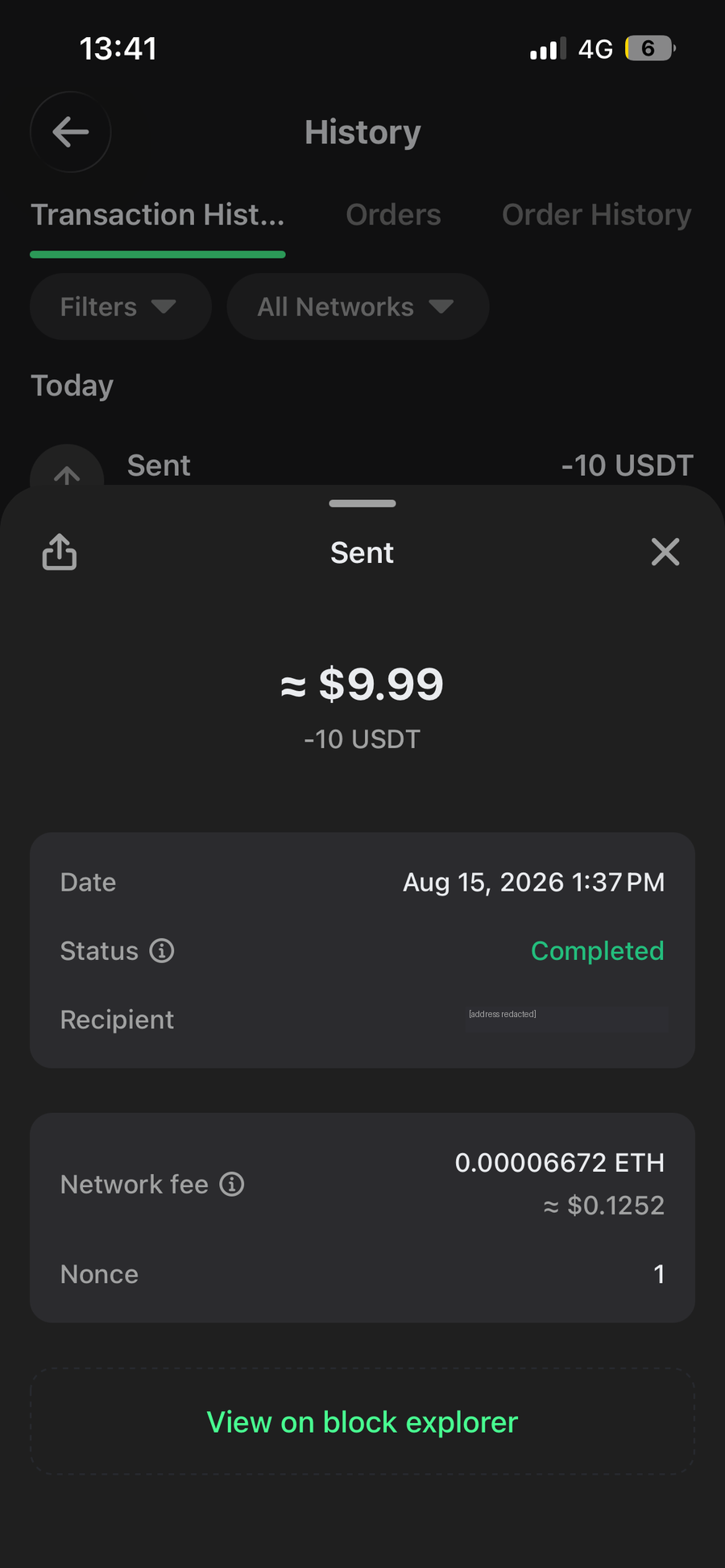
A $10 USDT-ERC20 deposit credited in about 55 seconds, confirmed on-chain.
CB deposited 10 USDT over ERC-20 from a Trust Wallet. The transfer credited to the Duel balance in about 55 seconds, with the wallet showing the send completed and Etherscan confirming it independently. One notable detail from the notes: the funds were immediately available to withdraw — CB could have withdrawn the balance straight away without a wagering step on this cycle.
03Cross-network withdrawals — a genuine cost-saver
One feature sets Duel apart from most platforms CB has tested: you can deposit on one network and withdraw on another. CB verified this directly — depositing over TRC-20 and withdrawing over Solana in an earlier test. The practical benefit is real money saved: TRON withdrawals on Duel carry a higher fee (~$4.38), so a user can deposit via TRC-20 and cash out via Solana or ERC-20 to route around the expensive network entirely. Duel's withdrawal form also correctly rejected a wrongly-formatted address during testing — a small but welcome safeguard.
04KYC — none across two full cycles
Duel scored top marks for privacy: no KYC, and not even an email required.
CB completed two full deposit-and-withdrawal cycles on Duel with no KYC prompt at any stage — and unusually, no email address was required to withdraw. Support indicated that identity checks are triggered by terms-of-service or compliance concerns rather than a stated financial threshold; one published figure suggests a $5,000 point, though support framed it as case-by-case. CB reports both.
The clean KYC result covers deposits and small withdrawals after light activity, across two cycles. Verification on crypto sportsbooks typically sits higher up — on larger withdrawals or flagged activity. Treat "no KYC" as verified for the amounts CB tested; larger or repeated withdrawals may prompt verification.
05Withdrawal fees — the lowest CB has measured
$0.16 on ERC-20, $0.15–$0.18 on Solana — the cheapest of any platform CB has tested.
Duel's withdrawal fees are a real strength. On ERC-20 CB was charged $0.16, and on Solana $0.15–$0.18 — the lowest withdrawal fees of any CB-tested platform, because Duel absorbs most of the network gas. On-chain, Etherscan showed the actual ERC-20 network cost at about $0.09, so the $0.16 charge is a small markup of a few cents in absolute terms. The one network to avoid is TRC-20 at ~$4.38 — but the cross-network feature means you never have to use it. The fees dimension scores 6.5: excellent absolute cost, with the small ERC-20 markup and the high TRC-20 rate noted.
06Bonus reality — the best structure CB has tested
Duel applies a 100% deposit-wagering requirement before withdrawal — but with a flexibility CB hasn't seen elsewhere. It's bypassable for an 8% processing fee, and support confirmed a deposit can be forfeited before any wagering begins. That's more accommodating than platforms that hard-block with no exit. Two things to note: the 8% bypass fee isn't prominently disclosed, and if a bonus is declined the wagering still applies to the deposit principal. On CB's most recent cycle, no wagering was required before withdrawal at all. Balanced out, this is the best bonus/withdrawal-flexibility structure CB has tested, scoring 8.5.
07Customer support
Support was fast and personable. Across two live-chat tests, CB saw sub-40-second responses to fee and cross-network questions, and a real agent ("Nick") who answered KYC and withdrawal-limit queries accurately. The tone was genuinely human and non-scripted — the strongest support tone of any platform CB has tested. The one deduction: the fee explanation was only partially accurate, described as an estimated average without acknowledging the small markup over actual cost. Support scores 8.25 (average of two tests).
08Games, markets and crypto support
Duel's library is broad: 5,000+ slots, 600+ live-casino tables, 48 sports and 17 esports, with key providers including Pragmatic Play, Hacksaw Gaming, Nolimit City and Evolution. Its 11 Duel Originals — Dice, Blackjack, Plinko, Crash, Mines and more — all run at a 100% RTP and are provably fair. There's no dedicated mobile app, though the site is mobile-optimised. Games scores 8.0.
On crypto, Duel supports 16 cryptocurrencies — BTC, ETH, USDT, USDC, SOL, XRP, DOGE, ADA, LINK, AVAX, TRX, BNB, LTC, BCH, HBAR and TON — with a fiat on-ramp via Swapped. There are no privacy coins, but the cross-network withdrawal support (verified by CB) adds real practical flexibility. Crypto scores 9.0.
09VIP, trust and longevity
Duel's loyalty model is unusual and, in CB's view, player-friendly: wager-free rakeback from the first bet — 50% on slots, up to 80% on Duel Blackjack — with no tier grind and an explicitly anti-VIP philosophy, alongside a daily leaderboard and monthly tournament prize pools. It's the best loyalty structure of any CB-tested platform, scoring 10.
On trust, Duel scores 7.0. It launched in July 2025 — just over a year old — operated by Immortal Snail LLC, registered in Nevis, under an Anjouan gaming licence (ALSI-202411026-FI1). The founder is the team behind CSGOEmpire, which carries a multi-year track record, and CB found SSL, 2FA and provably-fair Originals with no significant complaint pattern. The score is held back by the platform's youth and the offshore (Anjouan) licence, a lighter jurisdiction than some alternatives.
Duel states it does not offer services to residents of: Afghanistan, Armenia, Germany, Iran, Iraq, Jordan, Kuwait, Lithuania, North Korea, Saint Kitts and Nevis, Slovakia, Spain, Syria, Yemen, the United Arab Emirates, Montenegro, the United Kingdom, the United States and its territories, France, the Netherlands (including Curaçao and other territories of the Kingdom of the Netherlands), Australia, Venezuela, the Democratic Republic of Congo, Libya, Somalia, Myanmar/Burma, Sudan, South Sudan, Mali and the Central African Republic. This is operator-stated and can change — always check Duel's current terms before registering, as attempting to access from a restricted region can put your funds and account at risk.
10How CB scored it — a provisional card
Duel has been tested on nine of ten dimensions. Odds quality is still to come, so this score is provisional.
Nine of CB's ten methodology dimensions have now been tested on Duel with real money — every score below is a measured result, not a commitment taken on trust. The one gap is odds quality (15% weight), which CB hasn't yet sampled. The overall of 8.9 is the weighted average of what's been tested at 85% coverage, and may move once odds are measured. The full breakdown is below.
Duel is tested to 85% coverage — nine of ten dimensions scored from a documented real-money test, with odds quality still to come. Weighting follows CB's published methodology (withdrawal 25%, bonus 15%, odds 15%, KYC 10%, support 10%, fees 8%, games 7%, crypto 6%, trust 2%, VIP 2%); the overall is the weighted average of tested dimensions only.
Tested by Crypto Bettors with real money between 15 June and 16 August 2026. Every figure is a point-in-time observation from a documented test; operator terms, fees and bonuses change, so verify current conditions on Duel.com before depositing. This is CB's own experience, not a guarantee of yours.